As part of the Sense4Fire project, several approaches have been or are being developed, tested and used in different study regions around the world and for different years, involving the use of different input dataset for burnt area and different configurations of the GFA-S4F, TUD-S4F and KNMI-S5p approaches. Below you find the definition of the study regions used in Sense4Fire, an overview about the development of the Sense4Fire database and all datasets, and a list of all available output variables.
Study regions
Table. Overview about the study regions used in Sense4Fire.
Study region or test area
East/West extent
North/South extent
Included in Database Version
Amazon study region, including the Cerrado biome
40°W - 80°W
25°S - 10°N
DBv1, DBv2, DBv3
S-Africa: southern Africa study region
10°E - 30°E
5°S - 25°S
DBv1, DBv2, DBv4
Sahel study region
10°E – 43.3°E
0° - 18.1°N
DBv4 (in development)
Europe study region, covering mainly the Mediterranean
Default TUD-S4F setup in DBv4 with new representation of surface live woody vegetation, ESA WorldCover as land cover and prolonged burnt area time series (FireCCI51 2014-2018 + FireCCIS311 2019-2024)
Default TUD-S4F setup in DBv2 with ESA CCI land cover and GFA-S4F burnt area for the year 2020 (FireCCI51 for the other years), dynamic emission factors
Top-down estimates of CO and NOx emissions using the beta-method
Database development
Database version 4 (DBv4): Near-real time and high-resolution emissions for Africa
The fourth version of the Sense4Fire database provides advanced methodologies for two study regions in Africa, the southern Africa study region and the Sahel. DBv4 provides refined setups of GFA-S4F and TUD-S4F to provide fire emission estimates with low latency, i.e. as provisional (PRV) analysis up to the previous year or as near-real time (NRT), here defined as providing fire emission estimates with a latency of <1 month. In addition, DBv4 includes an unprecedented high resolution fire emission dataset based on the TUD-S4F approach with a high spatial resolution (HR, 20 m).
The first datasets of DBv4 were published in April 2026 and further datasets are added during 2026.
Database version 3 (DBv3): Near-real time analysis of the Amazon 2024 fire season
The Amazon experienced an exceptional extreme fire season in 2024. During this season, the Sense4Fire project provided updates of fire emissions from the GFA-S4F and TUD-S4F approaches. The purpose of DBv3 – published consecutively during the second half of 2024 – was to demonstrate the near-real time capabilities of the Sense4Fire approaches in providing estimates of fire emissions. Results are available for the Amazon/Cerrado study region for the year 2024. DBv3 forms the foundation of the results published in de Laat et al. (2026).
Database version 2 (DBv2): The Sense4Fire baseline
The second version of the Sense4Fire Database was published in October 2023 with results for the Amazon/Cerrado, southern Africa, Europe, and Siberian study regions. For TUD-S4F, the products and factorial experiments in DBv2 are the baseline products for all study regions. The results for the Amazon/Cerrado study region in DBv2 are for the results published in Forkel et al. (2025).
Database version 1 (DBv1): Initial developments
The first version of the Sense4Fire Database was made available in May 2023 and provided the first products for the Amazon, southern Africa, Europe, and Siberian study regions. The KNMI-S5p dataset remains the same in version 02 of the Experimental Database. The GFA-S4F datasets for southern Africa, Siberia and Europe remain the same in version 02 of the database. The highly experimental TUD-S4F datasets in DBv1 are deprecated. Users should refer for TUD-S4F results in DBv2.
Definition of output variables
The following variables are available from Sense4Fire:
Table. Overview about the output variables produced in Sense4Fire.
Variable
Description
Unit
Type
Approach
e_co
fire emissions of carbon monoxide
g/m²
Emission
GFA-S4F, KNMI-S5p, TUD-S4F
e_co2
fire emissions of carbon dioxide
g/m²
Emission
GFA-S4F, TUD-S4F
e_ch4
fire emissions of methane
g/m²
Emission
GFA-S4F, TUD-S4F
e_pm25
fire emissions of particulate matter 2.5 micron
g/m²
Emission
GFA-S4F, TUD-S4F
e_nox
fire emissions of nitrogen oxides
g/m²
Emission
GFA-S4F, KNMI-S5p, TUD-S4F
ef_co
emission factor carbon monoxide
g/kg
Emission factor
TUD-S4F
ef_co2
emission factor carbon dioxide
g/kg
Emission factor
TUD-S4F
ef_ch4
emission factor methane
g/kg
Emission factor
TUD-S4F
ef_pm25
emission factor particulate matter 2.5 micron
g/kg
Emission factor
TUD-S4F
ef_nox
emission factor nitrogen oxides
g/kg
Emission factor
TUD-S4F
mce
modified combustion efficiency
unitless
Combustion efficiency
TUD-S4F
bm_wood
woody biomass of trees
kg/m²
Fuel load
TUD-S4F
bm_leaf
leaf biomass of trees
kg/m²
Fuel load
TUD-S4F
bm_herb
herbaceous biomass (incl. crops)
kg/m²
Fuel load
TUD-S4F
bm_slw_wood
woody biomass of surface live woody vegetation
kg/m²
Fuel load
TUD-S4F (>= v0.3)
bm_slw_lead
Leaf biomass of surface live woody vegetation
kg/m²
Fuel load
TUD-S4F (>= v0.3)
fwd
fine woody debris (diameter < 7.62 cm)
kg/m²
Fuel load
TUD-S4F
cwd
coarse woody debris (diameter > 7.62 cm)
kg/m²
Fuel load
TUD-S4F
litter
litter (dead herbaceous and leaf material)
kg/m²
Fuel load
TUD-S4F
dmb_total
total dry matter burned (named fc_total before DBv4)
kg/m²
Fuel consumption
GFA-S4F, TUD-S4F
dmb_stem
dry matter burned consumption of tree stem biomass (named fc_stem before DBv4)
kg/m²
Fuel consumption
TUD-S4F
dmb_branches
dry matter burned from consumption of tree branches biomass (named fc_branches before DBv4)
kg/m²
Fuel consumption
TUD-S4F
dmb_leaf
dry matter burned from consumption of tree leaf biomass (named fc_leaf before DBv4)
kg/m²
Fuel consumption
TUD-S4F
dmb_herb
dry matter burned from consumption of herbaceous biomass (named fc_herb before DBv4)
kg/m²
Fuel consumption
TUD-S4F
dmb_fwd
dry matter burned emissions from consumption of fine woody debris (named fc_fwd before DBv4)
kg/m²
Fuel consumption
TUD-S4F
dmb_cwd
dry matter burned emissions from consumption of coarse woody debris (named fc_cwd before DBv4)
kg/m²
Fuel consumption
TUD-S4F
dmb_litter
dry matter burned emissions from consumption of leaf and herbaceous litter (named fc_litter before DBv4)
kg/m²
Fuel consumption
TUD-S4F
dmb_slw_leaf
dry matter burned emissions from consumption of surface live woody vegetation leaves
kg/m²
Fuel consumption
TUD-S4F (>= v0.3)
dmb_slw_wood
dry matter burned emissions from consumption of surface live woody vegetation wood
kg/m²
Fuel consumption
TUD-S4F (>= v0.3)
fmc_live
live fuel moisture content of leaves and herbaceous vegetation
Sense4Fire provides two bottom-up fire emission approaches (GFA-S4F and TUD-S4F) and a set of approaches (summarised as KNMI-S5p) to provide a top-down benchmark of estimated fire emissions:
The GFA-S4F approach is based on the Global Fire Atlas (GFA) algorithm and uses observations of active fires from the VIIRS instrument and of Sentinel-2-derived burnt area maps to provide near-real time estimates of burnt area and performs a mapping of fire types to estimate fire emissions (Andela et al., 2019, 2022a)
The TUD-S4F approach is a data-model fusion approach that combines several Earth observation products from the Sentinels, from ESA’s Climate Change Initiative (CCI) and from the Copernicus Global Land Service (CGLS) to estimate fuel loads, fuel moisture, fuel consumption, and fire emissions (Forkel et al., 2025)
KNMI-S5p is a set of approaches that uses observations of atmospheric CO and NOx with Integrated Forecasting Model (IFS) to evaluate bottom-up fire emission estimates. The approaches have been used in Forkel et al. (2025) to evaluate emissions estimates from GFA-S4F and TUD-S4F, among others.
The development of the three Sense4Fire approaches along with their versioning, application to different study regions, and the related deliverables and publications are shown in theTable.
The three approaches are described in scientific publications (Andela et al., 2022a; Forkel et al., 2025; de Laat et al., 2026) and all most recent updates of each approach are described in the Algorithm Theoretical Baseline Document version 4 (ATBDv4)
The GFA-S4F and TUD-S4F approaches are developed to be capable of providing fire emission estimates with low latency, i.e. as provisional (PRV) analysis up to the previous year or as near-real time (NRT), here defined as providing fire emission estimates with a latency of <1 month
Table: Development of the Sense4Fire approaches with the related versions of Algorithm Theoretical Baseline Documents (ATBD), Product Validation Reports (PVR), Impact Assessment Reports (IAR), Databases (DB)
Approach and version
Short description
Related ATBDs, PVRs and IARs
Study region and temporal coverage
Publication
Related Database
Data publication date
GFA-S4F-v0.3
Based on GFA-S4F-v0.1 but with updated estimation of NRT burnt area based on Sentinel-2 for Africa
ATBDv4, PVRv4
S-Africa 2019-2025
DBv4
Apr 2026
Sahel 2019-2025
DBv4
Sep 2026
GFA-S4F-v0.2
Based on GFA-S4F-v0.1 but with improved parametrization for NOx emissions and prolonged time series (2019-2024)
ATBDv2.1, ATBDv3, IARv2.1
Amazon/Cerrado 2018-2025
DBv4
Mai 2026
Amazon/Cerrado 2024 (de Laat et al., 2026)
DBv3
Dec 2024
Amazon/Cerrado 2019-2023 (Forkel et al., 2025)
DBv2
Oct 2023
GFA-S4F-v0.1
Original description of the GFA-S4F approach based on Andela et al. (2022)
ATBDv1, PVRv3
Amazon/Cerrado, Europe, S-Africa, and Siberia 2020
DBv1
Nov 2021
TUD-S4F-v0.3
Based on TUD-S4F-v0.2 but with new input datasets and representation of surface live woody vegetation
ATBDv4, PVRv4
S-Africa 2014-2024/2025
DBv4
Apr 2026
Sahel 2014-2024/2025
DBv4
Sep 2026
TUD-S4F-vNRT01
Near-real time setup based on a machine learning model trained against TUD-S4F-v0.2
IARv2.1
Amazon/Cerrado 2024 (de Laat et al., 2026)
DBv3
Dec 2024
TUD-S4F-v0.2
Default setup of TUD-S4F for all study regions
ATBDv2.1, ATBDv3, PVRv3, IARv2.1
Amazon/Cerrado (Forkel et al., 2025), Europe, S-Africa, and Siberia 2014-2021
DBv2
Oct 2023
TUD-S4F-v0.1 (deprecated)
Initial version of the TUD-S4F approach, replaced by TUD-S4F-v0.2
ATBDv1, PVRv2.1
Amazon/Cerrado, Europe, S-Africa, and Siberia 2014-2021
DBv1
Nov 2021
KNMI-S5p-v0.2
Revised setup of the IFS model
ATBDv4, PVRv4
S-Africa, Sahel
-- (use for validation in DBv4.0/ 4.1)
Sep 2026
KNMI-S5p-v0.1
Initial description of approach
ATBDv2.1, ATBDv3, PVRv3
Amazon/Cerrado (Forkel et al., 2025; de Laat et al., 2026), Europe, S-Africa, and Siberia 2020
DBv1/v2
Nov 2021
GFA-S4F: near real time fire types and emissions
The GFA-S4F approach introduces an object-based methodology, building on the Global Fire Atlas and Amazon Dashboard (Andela et al., 2019, 2022b), to track individual fires and their characteristics. GFA-S4F makes use of active fire observations from VIIRS. Active fire detections are clustered into fire events using the Fire Atlas algorithm. The size of fire events is then scaled with burnt area from Sentinel-2 imagery to provide realistic near-real time estimates of burnt area. Fire Radiative Energy (FRE) is derived from Fire Radiative Power (FRP) by computing the average FRP over fire duration (i.e. FRP density) and by multiplying with fire duration, providing detailed insights into fire duration and energy release.
Fire types are then estimates by combining properties of indivdiuals fires with land cover information to estimate fire emissions. Fires are clustered into categories like cropland, grassland, savannah, and forest fires.
TUD-S4F: fuels, dry matter burnt and emissions
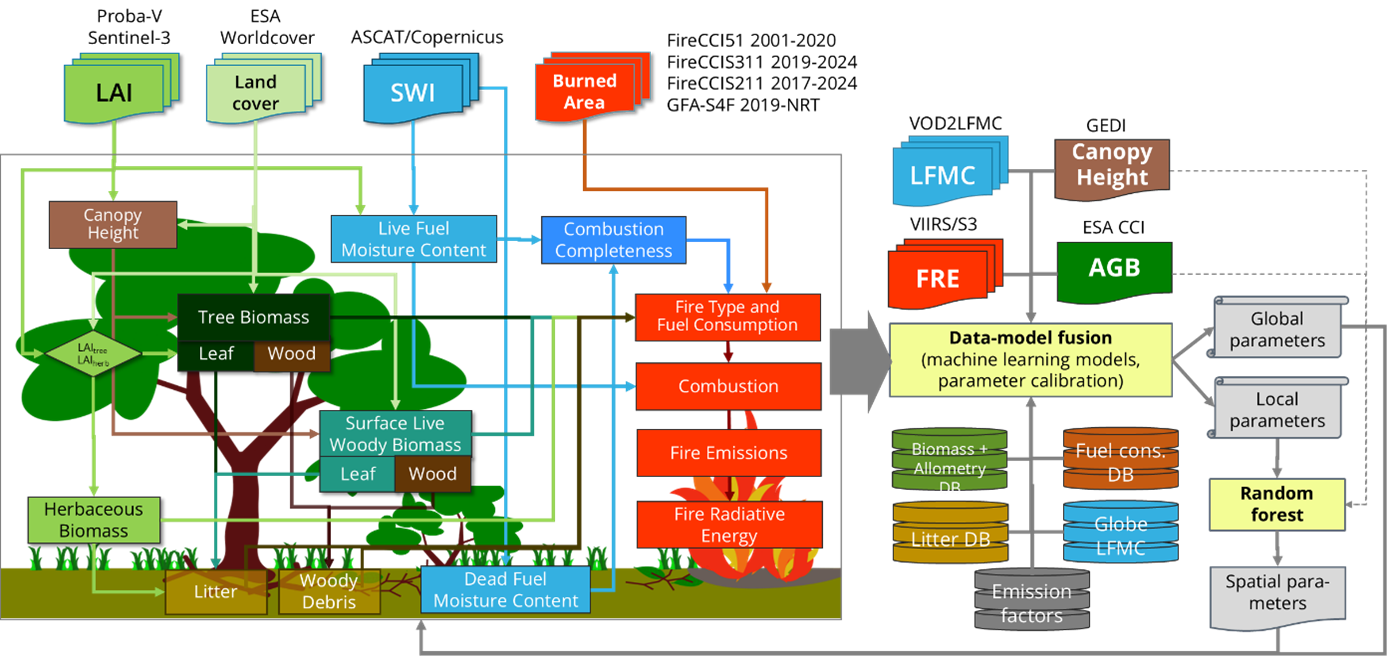
TUD-S4F is a data-model fusion approach that integrates different Earth observation products such as land cover, leaf area index (LAI), soil water index (SWI), and burnt area within a simple ecosystem model to estimate the spatial patterns and temporal dynamics of biomass, fuel loads and fuel moisture, combustion completeness, fuel consumption, combustion efficiency, emission factors, and fire emissions (Figure). The approach has been introduced and applied in Forkel et al. (2025), which assesses the role of woody debris on fire emissions in the Amazon and Cerrado.
Figure: Schematic structure of the TUD-S4F-v0.3 approach to estimate fuel loads, fuel moisture, fuel consumption and fire emissions. Various satellite datasets are used a forcing (top) or for training of machine learning models and the calibration of model parameters (right).
The TUD-S4F core model represents different biomass and fuel components such as tree leaves, branches and stems, herbaceous vegetation, surface live woody biomass (SLW, i.e. shrubs and understorey), surface litter, and fine and coarse woody debris (FWD, CWD). Biomass in trees and SLW vegetation is estimated from canopy height, LAI and land cover using allometric equations that are calibrated based on satellite products of canopy height and above-ground biomass. The accumulation of surface fuels is then estimated from changes in land cover and from seasonal and long-term temporal changes in LAI, which affect the turnover of herbaceous and leaf biomass to litter, and of branches and stems to FWD and CWD, respectively. Fuel moisture content (FMC) is estimated from SWI and LAI for leaves and herbaceous biomass (i.e., live-fuel moisture content, LFMC) and from SWI for live woody biomass. Additionally, SWI is used as a proxy for the dead fuel moisture content (DFMC) of surface fuels. The estimated FMC is then used to estimate combustion completeness.
Unlike in other fire emission inventories, TUD-S4F estimates emission factors dynamically dependent on the chemical composition of biomass and fuel components and fuel moisture by using a chemical-based combustion model. The combustion model is calibrated against field and laboratory databases of emission factors and against satellite observations of fire radiative energy.
KNMI-S5p: top down benchmarking of fire emissions
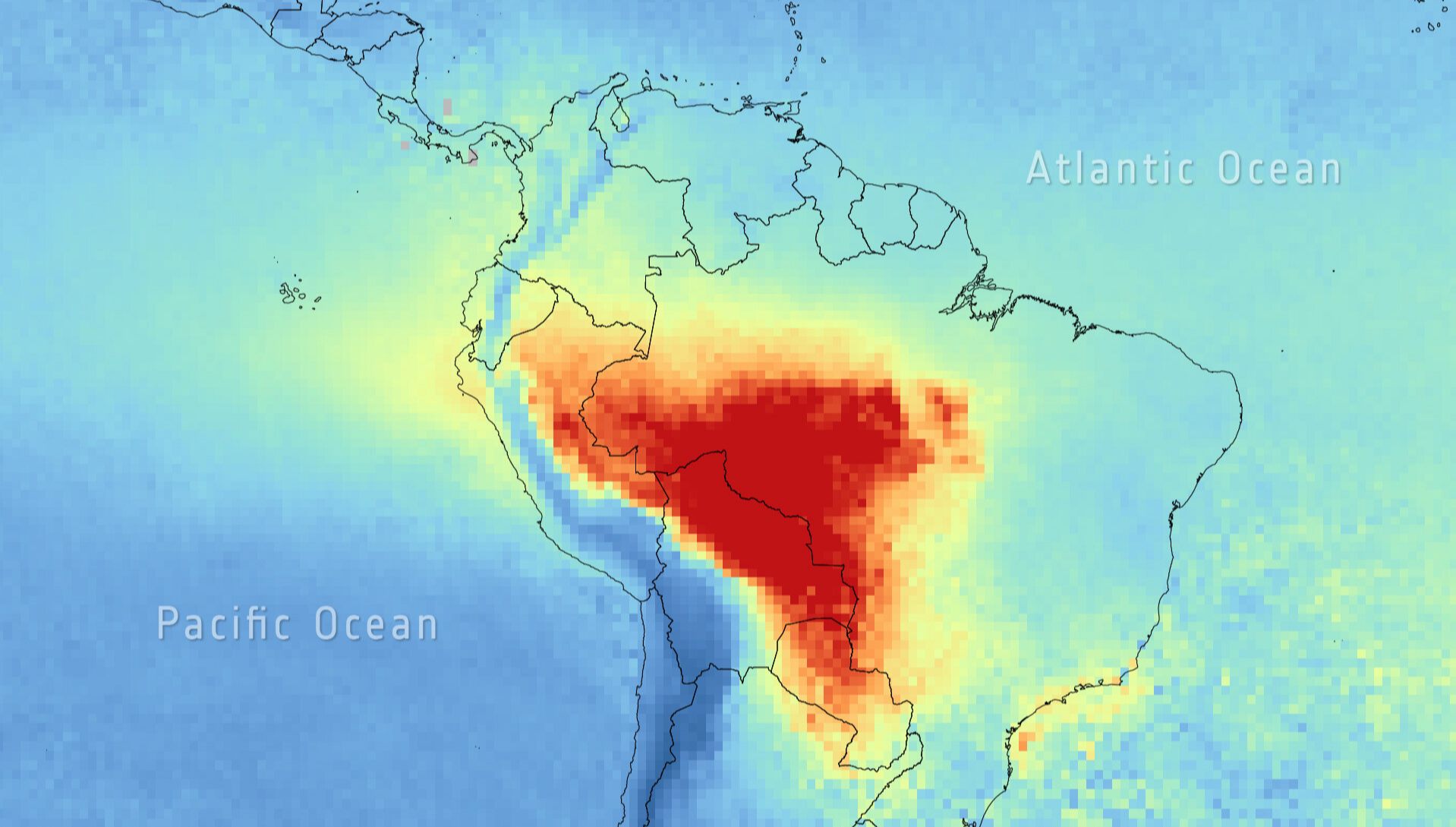
KNMI-S5p validation approach makes use of Sentinel-5p satellite observations from the TROPOspheric Monitoring Instrument (TROPOMI) of atmospheric composition and air pollution to provide top-down constraints on estimated fire emissions. The advance of TROPOMI has been so important for wildfire emission monitoring and for the first time allows for spatiotemporally detailed a continuous monitoring of wildfire emissions.
The KNMI-S5p approach to use an atmospheric chemistry-transport model as an interface between the wildfire emission estimates on the one hand and the satellite measurements of air pollution on the other hand. Bottom-up wildfire emission estimates – like from GFA-S4F and TUD-S4F – are into the model whose results are collocated with the satellite observations of air pollution. This provides an extensive dataset that can be used to explore how well the model reproduces the observations. Model simulations can be tweaked with other fire emission databases or modifications of those emission databases to bring model results and observations in closer agreement. For the short live trace gas nitrogen dioxide (NO2) the model simulations also allow for applying a post-hoc NO2 emission correction based on the modelled local sensitivity of tropospheric NO2 columns to local NO2 emissions, which has been applied – among others – in Forkel et al. (2025). Assuming linearity between both, that sensitivity – denoted as β-factor – can be multiplied with the differences between model simulated and observed tropospheric NO2 to a local multiplication factor which to first order brings model simulations and observations of tropospheric NO2 in better agreement.
Results in Sense4Fire indicated that CO was a useful addition to NO2. Both traces are emitted by wildfires but have different sensitivities to fire temperatures. Whereas NO2 emissions increase with increasing fire temperature – and thus indicate flaming fires with nearly complete combustion, CO emissions increase with decreasing fire temperatures. CO thus reflects incomplete combustion. The first results of the exploration of the use of TROPOMI measurements for wildfire emission monitoring have focused on short time periods of several months in single year with a focus Amazonia (Forkel et al., 2025; de Laat et al., 2026; other regions were sub-equatorial Africa, Mediterranean Europe and in Siberia).
Forkel, M., Wessollek, C., Huijnen, V., Andela, N., de Laat, A., Kinalczyk, D., Marrs, C., van Wees, D., Bastos, A., Ciais, P., Fawcett, D., Kaiser, J.W., Klauberg, C., Kutchartt, E., Leite, R., Li, W., Silva, C., Sitch, S., Goncalves De Souza, J., Zaehle, S., and Plummer, S. (2025). Burning of woody debris dominates fire emissions in the Amazon and Cerrado. Nature Geoscience, 18, 140–147, https://doi.org/10.1038/s41561-024-01637-5
This preprint presents the first evaluation of fire emission estimates using the KNMI-S5p approach.
Forkel, M., Wessollek, C., Huijnen, V., Andela, N., de Laat, A., Kinalczyk, D., Marrs, C., van Wees, D., Bastos, A., Ciais, P., Fawcett, D., Kaiser, J.W., Klauberg, C., Kutchartt, E., Leite, R., Li, W., Silva, C., Sitch, S., Goncalves De Souza, J., Zaehle, S., and Plummer, S. (2025). Burning of woody debris dominates fire emissions in the Amazon and Cerrado. Nature Geoscience, 18, 140–147, https://doi.org/10.1038/s41561-024-01637-5
This paper compares the three Sense4Fire approaches (TUD-S4F, GFA-S4F and KNMI-S5p) with other fire emission datasets and focusses specifically on the role of fuels for fire emissions. A full description of the TUD-S4F approach is given in the Methods and Supplementary Information.
Technical documents
A series of deliverables such as Algorithm Theoretical Baseline Documents (ATBD), Product Validation Reports (PVR) and Impact Assessment Reports (IAR) have been produced in Sense4Fire and published along with the Databases. In order to keep the list of deliverables concise for the potential user of our data products, we list and publish the documents that relate to a certain version of the database.
The fourth version of the Algorithm Theoretical Baseline Document (ATBDv4) provides an updated and complete description of the most recent versions (GFA-S4F-v0.3, TUD-S4F-v0.3, KNMI-S5p-v0.2) of three approaches used in Sense4Fire. The three approaches were previously described in ATBDv2.1 and ATBDv3 (Forkel et al., 2023b, 2024) as well as in the corresponding scientific publications (Andela et al., 2022; Forkel et al., 2025; de Laat et al., 2026). ATBDv4 documents advancements since ATBDv3, reflecting the integration of new Earth observation datasets and methodological developments in the approaches.
Table. Overview about key technical deliverbales in Sense4Fire.
Technical document
Content / Relation to Sense4Fire Database
Date
Link to document
Algorithm Theoretical Baseline Document version 4 (ATBDv4)
Complete description of all approaches used in Sense4Fire, including all updates for Database version 2 (DBv4)
Algorithm Theoretical Baseline Document version 3 (ATBDv3)
Update of ATBDv2.1 with description of setups and experiments for all study regions as presented in PVRv3 and for products published in Database version 2 (DBv2)
23-27 May 2022 | ESA Living Planet Symposium 2022, Bonn, Germany
Jos de Laat
On the use of daily Sentinel-5p trace gas and aerosol observations for characterising small-scale localised wildfires (Presentation)
Vincent Huijnen
Using Sentinel-5p trace gas and aerosol observations of fire plumes to constrain a global composition model: a critical assessment (Poster)
Matthias Forkel
Integrating the Sentinels for novel fuel, fire and emissions products to constrain the changing role of vegetation fires in the global carbon cycle (Presentation) (Poster)
Christine Wessollek
Estimating vegetation fuel loads for the quantification of fire emissions by integrating various Earth observation data (Poster)
Niels Andela
Understanding Earth Systems - Tracking Amazon fires in near-real time (Presentation)
23-28 April 2023 | EGU General Assembly 2023, Vienna, Austria
Matthias Forkel
Effects of land use, fuel loads and fuel moisture on fire intensity and fire emissions in South America derived by reconciling bottom-up and top-down satellite observations (Abstract) (Presentation)
Christine Wessollek
Estimating biomass compartments and surface fuel loads by integrating various satellite products with a data-model fusion approach (Abstract) (Presentation)
14-19 April 2024 | EGU General Assembly 2024, Vienna, Austria
Matthias Forkel
Multiple approaches for quantifying fuels, combustion dynamics, and regional fire emissions in the Amazon and Cerrado (Abstract) (Presentation)
Niels Andela
New insights on global fire extremes from object-based fire inventories (Abstract) (Presentation)
Dave van Wees
Comparison and validation of state-of-the-art fire emissions models for the Amazon (Abstract) (Presentation)
16-18 Sep 2024 | Fire Modelling Workshop; Leverhulme Centre for Wildfire, Science and Society; Dartington Hall, UK
Matthias Forkel
Vegetation-fire interactions: Role of dead wood
19-20 Sep 2024 | 13th EARSeL Forest Fires Special Interest Group Workshop, Milano, Italy
Matthias Forkel
Complementary Earth Observation Approaches to Advance Fire Emission Estimation (Book of abstracts)
26-28 Nov 2024 | Future Focus Wildfires. Community forum; EUMETSAT; Darmstadt, Germany
Matthias Forkel
Sense4Fire – novel fuel, fire and emission products (Presentation)
23-27 Jun 2025 | ESA Living Planet Symposium 2025, Bonn, Germany
Matthias Forkel
Novel Earth observation data-model fusion approaches reveal dominant role of woody debris in fire emissions in the Amazon and Cerrado
21 Jul 2025 | ESA International Workshop on Fire from Space, Harwell, UK
Matthias Forkel
Sense4Fire – Sentinel-based fuel, fire and emissions products to constrain the changing role of vegetation fires in the global carbon cycle
25-26 Jun 2026 | 14th EARSeL Workshop on Forest Fires, Lisbon, Portugal
Matthias Forkel
Estimating Fuels and Fire Emissions at 20 m Spatial Resolution in African Savannahs using the S4F Satellite Data-Model Fusion Approach (Poster)
Daniel Kinalczyk
Estimating Fuels and Fire Emissions in Near Real Time (NRT) in African Savannahs
21 Sep 2026 | CBC 2026 Connecting Biodiversity, Climate, and Human Behaviour Conference, Leipzig, Germany
Matthias Forkel
Fire, Fuels, and Feedbacks: Uncovering the Role of Vegetation Structure in Amplifying Climate-Driven Wildfire Emissions
The Sense4Fire project, funded by the European Space Agency (ESA), aims to increase the scientific understanding of dynamics and emissions of landscape fires and their role in the carbon cycle by integrating observations from the Sentinels into new Earth observation products.
Sense4Fire develops novel Earth observation approaches and datasets about fire dynamics and emissions. Fire dynamics encompass a broad range of processes, including pre-fire conditions of the land surface (i.e. fuel loads and fuel moisture), fire behaviour (fire ignitions, spread, speed, size, burnt area, fire type, and radiative power), combustion and production of fire emissions (combustion completeness, dry matter burnt, combustion efficiency, and composition of emissions) and the effect of fire emissions on atmospheric composition.
The Sense4Fire project is part of ESA’s Carbon Science Cluster. The project has been originally funded from August 2021 to July 2023 and has been prolonged twice until December 2026.
Datasets
High resolution fuel and fire emissions datasets are available for the Amazon/Cerrado, southern Africa, southern Europe and Siberia. Link to Data
Approaches
Sense4Fire provides two fire emission approaches (GFA-S4F and TUD-S4F) and a set of approaches based on Sentinel-5p (KNMI-S5p) to benchmark fire emissions. Link to Approaches
Publications
Work from Sense4Fire is published in a series of technical dcouments and in a series of high-level scientific publications. Link to Publications
.
Outreach
Vegetation fire dynamics from space
A groundbreaking study, partially funded by ESA, reveals that fire emissions in the Amazon and Cerrado are largely driven by the smouldering combustion of woody debris. This crucial discovery highlights the significant influence of fuel characteristics on fire emissions, with wide-ranging implications for global carbon cycles, air quality and biodiversity.
Amazon wildfire emissions up to three times higher than estimated
Wildfires that swept across the Amazon in 2024 were the most devastating in more than two decades. New research funded by the European Space Agency (ESA) suggests emissions may have been up to three times higher than earlier estimates.